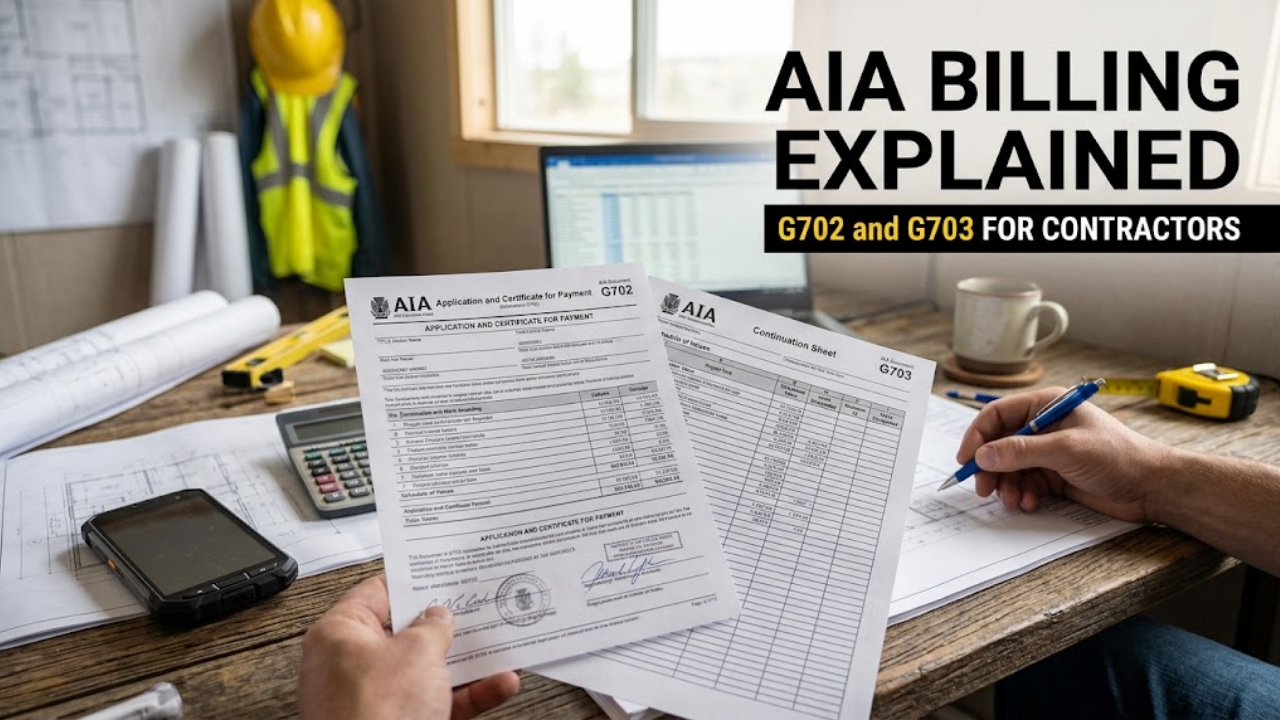
AIA Billing Explained: G702 and G703 for Contractors
Share this article
AIA billing is a construction progress billing process that commonly uses G702 to summarize a payment request and G703 to support it with detailed project values. Contractors report completed work, eligible stored materials, retainage, and previous certificates so the reviewer can verify the current amount due.
For commercial subcontractors and GCs, the challenge is keeping field progress, approved changes, and last month’s certified numbers aligned. Here is how to build an application that is easier to review and less likely to come back for corrections.
What is AIA billing, and when do contractors use it?
AIA billing takes its name from payment documents published by the American Institute of Architects. It is commonly used on US commercial projects when the contract requires standardized progress payment applications.
The two familiar forms serve different purposes:
G702, Application and Certificate for Payment: The summary of the contractor’s payment request, with a section for the architect’s certification.
G703, Continuation Sheet: The detailed breakdown supporting that request through a schedule of values.
A GC typically assembles its application for the owner’s review process. Subcontractors may submit similar applications to the GC using the forms, portal, or subcontract-specific documents required by their agreements. Do not assume every subcontract follows the owner’s architect certification route.
Unlike a basic invoice, the application reports cumulative contract progress, then subtracts previously certified amounts. It is not a timesheet, a cost report, or proof that payment has been received.
Official AIA documents are copyrighted and licensed. Obtain authorized forms when required, and confirm whether the project accepts an alternative format before building a spreadsheet version.
How do you build a schedule of values that supports payment?
A schedule of values divides the contract price into measurable billing items. Its total must match the applicable contract sum, with approved changes incorporated consistently as the job progresses.
For a mechanical subcontractor, useful lines might include mobilization, equipment procurement, underground piping, rough-in, equipment installation, controls, testing, and closeout. One line called “mechanical work” gives the reviewer little basis for approving partial completion.
Build the schedule before the first application:
Follow the required breakdown. Match the GC’s requested phases, areas, or specification sections.
Assign defensible values. Include appropriate overhead and profit within the agreed structure rather than loading unsupported value into early work.
Separate measurable milestones. Make it possible to verify progress through quantities, areas, or completed activities.
Obtain required acceptance. Resolve questions about the allocation before the billing deadline.
Keep line numbering stable. Add approved changes clearly instead of silently rewriting earlier applications.
Connect billing lines to cost codes where practical, but remember that scheduled value is a selling-price allocation, not your internal cost budget. Spending half the labor budget does not prove that half the scope is complete. Our step-by-step construction job costing guide explains how to track the cost side separately.
How do you complete G703 without double billing?
Complete G703 first because its totals feed G702. Each row should show a clear progression from scheduled value to completed work, currently stored materials, and remaining work.
The standard columns are:
A and B: Item number and description of work.
C: Scheduled value for that item.
D: Work completed from previous applications, generally the previous application’s D plus E.
E: Work completed during the current period.
F: Materials presently stored, excluding materials already included as completed work.
G: Total completed and stored to date, calculated as D + E + F.
Percentage complete: G divided by C.
H: Balance to finish, calculated as C minus G.
I: Retainage by line item, where applicable.
Column F is a current balance, not a running total of everything purchased. When previously billed stored materials are installed, move their value into completed work and reduce stored materials accordingly. That transfer alone should not increase the total earned value.
Support stored materials with the evidence the contract requires, such as invoices, delivery records, photographs, insurance, and proof of ownership. Off-site storage may require advance approval and additional protection for the owner.
Validate completion with the superintendent or foreman before submission. A percentage entered to meet a cash target is not a defensible measure of progress.
How do you calculate G702 and the current payment due?
G702 converts the detailed G703 totals into a current payment request. The central calculation is completed and stored value, less retainage, less previous certificates for payment.
The following example uses two separate hypothetical contracts with identical figures in their respective currencies. The USD and CAD columns are not exchange-rate conversions; taxes and project-specific adjustments are excluded.
G702 lineCalculation or sourceUSD exampleCAD example1. Original contract sumSigned contract100,000100,0002. Net change by change ordersApproved additions less deductions10,00010,0003. Contract sum to dateLine 1 + line 2110,000110,0004. Total completed and storedG703 column G total55,00055,0005. Retainage10% assumed for this example5,5005,5006. Total earned less retainageLine 4 minus line 549,50049,5007. Less previous certificatesPreviously certified amount30,00030,0008. Current payment dueLine 6 minus line 719,50019,5009. Balance to finish, including retainageLine 3 minus line 660,50060,500
Line 7 is not cash received. If a previously certified application remains unpaid, track that amount in accounts receivable rather than billing it again in the current application. Reconcile against the actual prior certification, especially if the reviewer reduced your earlier request.
Retainage may differ between completed work and stored materials or change after contractual milestones. Use the applicable contract and legal requirements, not an assumed standard percentage.
Also note that G703’s balance to finish excludes retained amounts, while G702 line 9 includes them. Those totals should not be forced to match.
Which mistakes most often delay payment?
Payment applications commonly stall when the numbers cannot be reconciled or the required supporting documents are missing. A correct total will not fix an incomplete submission package.
Billing unapproved changes as approved contract value. Keep pending changes separately identified and follow the contract’s authorization process.
Using unsupported completion percentages. Agree on measurable progress with the field team and reviewer.
Double counting stored materials. Remove installed materials from column F when transferring their value to completed work.
Carrying forward the wrong previous amount. Use certified history, not an unreconciled draft or bank deposit total.
Applying retainage incorrectly. Check rates, exceptions, reductions, and release conditions.
Omitting required attachments. Check waiver requirements, statutory declarations, payroll records where applicable, and material documentation.
Missing the cutoff or signature requirements. Verify submission dates, portal rules, authorized signatures, and notarization where required.
Review lien waivers carefully. Do not represent that funds have cleared when they have not, and use the appropriate conditional or unconditional document for the jurisdiction and payment status.
Late closeout paperwork can also hold up final payment. The same issue appears in how almost-finished jobs tie up contractor cash flow: physical completion and payment readiness are different milestones.
Does AIA billing work differently in Canada?
AIA forms are not the universal billing standard in Canada. Canadian projects may use CCDC-related processes, consultant payment certificates, or owner-specific forms, although some contracts require AIA-style applications.
The underlying arithmetic is familiar: agreed value, completed work, eligible stored materials, previous certificates, and amounts withheld. The legal treatment needs separate attention.
US retainage requirements vary by state, contract, and project type. In Canada, statutory lien holdback and contractual retainage are not automatically interchangeable. Applicable provincial or territorial rules can affect amounts, release dates, and payment obligations; federal requirements may also apply.
Confirm proper-invoice requirements, prompt-payment deadlines, holdback treatment, and GST/HST or other applicable taxes. A completed G702 does not automatically satisfy every legal invoicing requirement. See our guide to managing progress billing in Canada for additional workflow considerations.
What monthly workflow makes progress billing easier?
A dependable billing cycle starts before the submission deadline and assigns responsibility for every input. The office should not have to reconstruct a month of field activity on billing day.
Confirm the cutoff. Record the billing period, submission date, required format, and reviewer.
Collect field evidence. Gather installed quantities, progress photos, delivery records, and scope updates.
Reconcile changes and storage. Separate approved changes from pending requests and verify stored-material balances.
Prepare and cross-check. Complete G703, transfer totals to G702, and check previous certificates and retainage.
Review and submit. Have a second person check calculations, attachments, signatures, and submission receipt.
Track certification and collection. Record revisions, certified amounts, due dates, and receipts separately.
Job costing and operational records support this process without replacing the contract-required application. Tradetraks brings together financial and job costing tools through FinTrak, operations through OpsTrak, and time tracking through TimeTrak. Better source records give your billing team more reliable information to work from.
Make every payment application easier to approve
Accurate AIA billing starts with a clear schedule of values and ends with a reconciled, documented submission. Keep earned value, certified amounts, and cash received separate, and treat billing readiness as part of project execution.
Want better visibility into the job information behind your payment applications? Book a Personalized Demo of Tradetraks. Built by the Trades, for the Trades.
Frequently asked questions
What is the difference between G702 and G703?
G702 summarizes the payment application, while G703 provides its line-by-line supporting calculations. G702 shows the contract sum, approved changes, earned value, retainage, previous certificates, and current payment due. G703 breaks the contract into scheduled values and tracks completed work and stored materials. Complete and reconcile G703 before transferring its totals to G702.
How do you calculate the current payment due on G702?
Current payment due equals total completed work and eligible stored materials, minus retainage, minus previous certificates for payment. On standard G702, subtract line 7 from line 6 to calculate line 8. Previous certificates are not the same as cash received, so unpaid certified amounts should not be added to the current request again.
Can you bill for stored materials on an AIA payment application?
You can bill eligible stored materials when the contract permits it and you provide the required evidence. Requirements may include invoices, insurance, proof of ownership, photographs, and approval of the storage location. Off-site storage often needs additional approval. Once materials are installed, transfer their value from stored materials to completed work without billing it twice.
Is AIA billing required for construction projects in Canada?
AIA billing is not a universal requirement for Canadian construction projects. Canadian contracts may use CCDC-related processes, consultant certificates, or owner-specific payment forms instead. A project can still require an AIA-style application. Follow the contract alongside applicable provincial or territorial lien, holdback, and prompt-payment rules, plus federal requirements where relevant.